
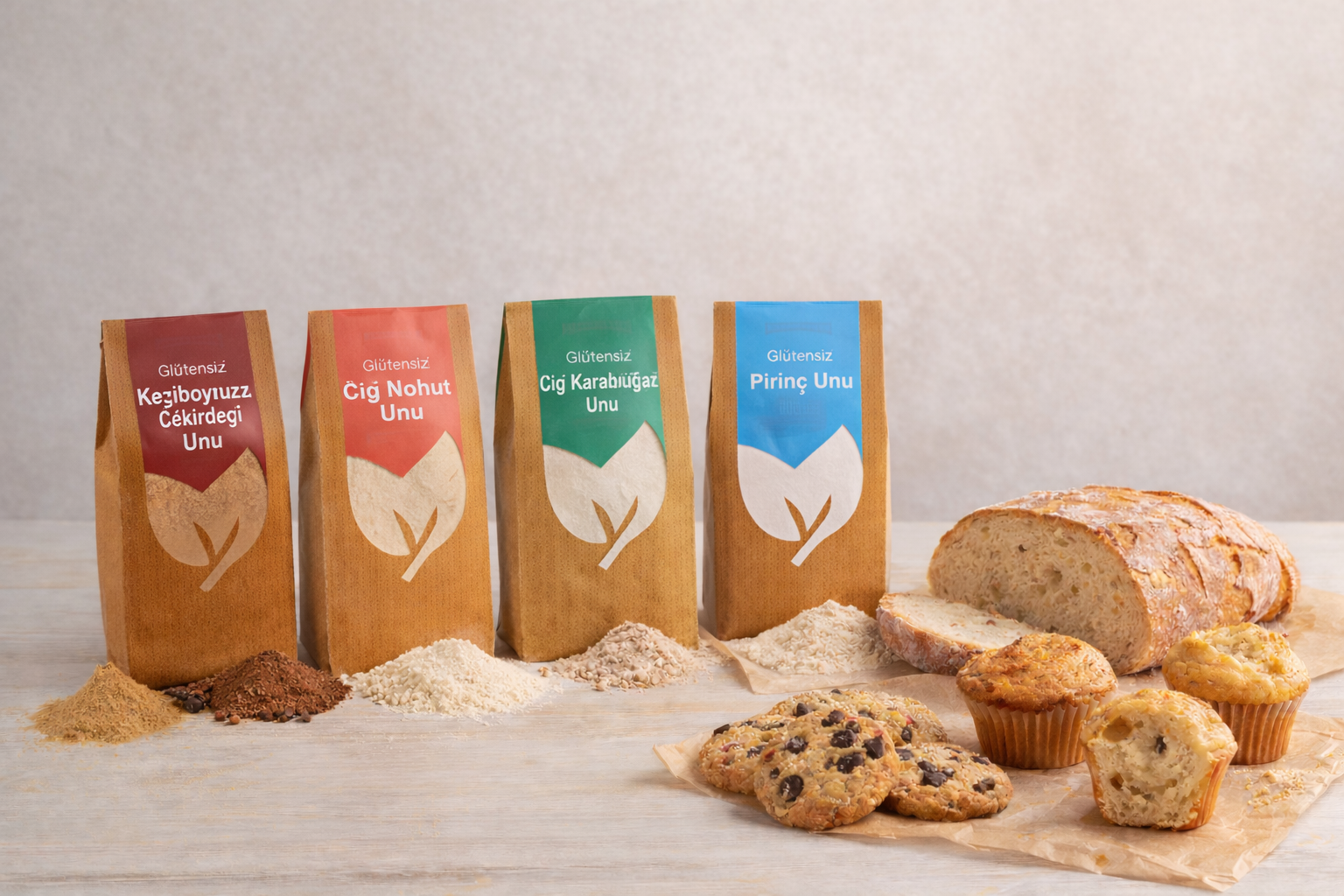
Gluten free flours are products used in place of conventional wheat flour, and each one can affect the structure of a recipe in a different way. Although many types are grouped under the same general label, they do not behave the same in the kitchen. Coconut flour, gluten free rice flour, raw buckwheat flour, chickpea flour, and gluten free locust bean gum flour may appear in the same category, yet their texture, liquid absorption, aroma, and baking performance are clearly different. For that reason, they should not be treated as interchangeable products.
The main issue when working with gluten free flours is knowing which one gives the most suitable result in which kind of recipe. Some flours have a more neutral taste and can be used more broadly. Others have a more distinct aroma and work better in specific preparations. For example, gluten free rice flour creates a milder and simpler base, while coconut flour affects both aroma and texture much more strongly. In a similar way, chickpea flour may produce a denser mixture, while raw buckwheat flour can lead to a more characterful and earthy result.
What makes these products important in the kitchen is not only that they are gluten free. They also create different textural options in recipes. When preparing pancakes, cookies, cakes, crepes, savory doughs, or certain baked items at home, the type of flour used becomes one of the most decisive factors in the final result. For that reason, the question of which recipes use gluten free flours cannot be answered simply by listing product names. It is also necessary to understand how each flour behaves with liquids, which recipes it supports best, and where it works better as a main flour or as a supporting ingredient.
For more controlled results in the kitchen, gluten free flours need to be understood on their own terms. Simply replacing one flour with another is usually not enough. The balance of eggs, milk, yogurt, oil, and sweeteners often needs to be adjusted according to the selected flour. The most accurate way to answer the question is to evaluate each flour according to recipe type and structural role. This makes both product choice and recipe development easier and more efficient.
How Do Gluten Free Flours Give Different Results in Recipes?
The first reason gluten free flours create different results is their absorption level. Some flours absorb liquid very quickly and make the mixture thicker than expected. Coconut flour is one of the clearest examples of this. Even a small amount can noticeably affect the balance of eggs, milk, or yogurt in a recipe. For that reason, measurement is especially important when using coconut flour. If it is used the same way as conventional flour, the mixture may become dry or overly dense after baking.
By contrast, gluten free rice flour often creates a more neutral and lighter result. It supports structure without changing the flavor of the recipe too much. Because of this, it can work well in crepes, pancakes, cookies, and lighter dough based recipes. Since rice flour does not have a strong aroma, it can be combined more flexibly with other ingredients. Still, when used alone, it may sometimes produce a more fragile or crumbly structure. In such cases, combining it with another flour can create a better balance.
Raw buckwheat flour has a more distinctive character. Its color, aroma, and texture are more noticeable in the final result. That means it is not equally suitable for every recipe. It often performs better in denser preparations or in recipes where a more pronounced flour character is welcome. Chickpea flour works in a similar way by giving mixtures a fuller and heavier body. It may be used in savory pancakes, crepe style preparations, baked mixtures, or more compact doughs. If the proportion is not handled carefully, chickpea flour may make the result feel heavier than intended.
Gluten free locust bean gum flour follows a different logic from the others. It should not always be thought of as the main flour in a recipe. In some preparations, it may be used more as a structural support, helping the overall consistency of the mixture. For that reason, not all gluten free flours belong in the same role. Some work as the main flour, some support texture, and others contribute aroma or control. Recipe success depends largely on making that distinction correctly.
In Which Pastries and Desserts Are Gluten Free Flours Used?
Gluten free flours are most often used in cakes, cookies, pancakes, crepes, and certain soft baked recipes. Still, not every flour works equally well in every category. For example, gluten free rice flour may be easier to use in simple cookie doughs, pancake batters, and thin crepe style recipes because of its relatively neutral structure. It can create a lighter result in recipes where a mild flavor is preferred. If other ingredients are meant to stand out more clearly, rice flour often offers a balanced base.
Coconut flour is more often used in small cakes, muffin type recipes, denser pancake mixtures, and certain sweet snacks. Because it has its own aroma, it changes the overall identity of the recipe more visibly. For that reason, it should be seen not just as a different flour, but as a structural and aromatic choice. It can also be used in cookies, but in many cases it works better when combined with another flour. If used alone, the result may become too dry or fragile.
Chickpea flour and raw buckwheat flour tend to perform better in denser recipes. Chickpea flour can work well in savory pancakes, crepe like preparations, and some baked mixtures. Buckwheat flour often fits better in more rustic cakes, fuller batters, and recipes where a grain like character is welcome. Neither of these flours behaves like a plain white flour. Both influence texture and flavor more directly. Because of this, their proportions should always be adjusted according to the type of recipe.
Gluten free locust bean gum flour may also be used in some mixtures to support consistency. In recipes where different gluten free flours are combined, it can play a more technical and balancing role. The important point is to understand it not always as the main flour, but as one part of a broader mixture. In short, gluten free flours can be used in sweet recipes, savory doughs, breakfast preparations, and baked goods, but the best result comes from matching the right flour with the right recipe structure.
What Should Be Considered When Choosing and Storing Gluten Free Flour?
The first thing to consider when choosing a gluten free flour is the intended recipe. Coconut flour, rice flour, chickpea flour, raw buckwheat flour, and gluten free locust bean gum flour are not direct replacements for one another. Before purchasing, it is useful to know whether the flour will be used for cake, pancakes, crepes, cookies, or savory doughs. This prevents unrealistic expectations and leads to more controlled results. Product selection should always be linked to recipe purpose.
A second important point is appearance. The flour should not be clumped, uneven, or overly moist in appearance. Coconut flour should not smell overly heavy, rice flour should look clean and simple, while buckwheat flour and chickpea flour should retain their natural tone without giving the impression of spoilage. Packaging should be intact, ingredient information should be clear, and the overall structure of the product should look stable. Products that present clear information are easier to use with confidence in the kitchen.
During storage, air and moisture control are the main priorities. Once opened, gluten free flours should be kept in airtight containers. Glass jars or well sealed storage boxes are practical options. This is especially important for products such as coconut flour, which may be more sensitive in structure. A flour that absorbs moisture may quickly clump and perform poorly in recipes. For that reason, these products should be stored in a cool, dry cupboard away from direct sunlight.
Care is also needed during everyday use. Taking flour with a wet spoon, leaving the container open too long, or keeping it in a warm environment can affect the product structure. It is useful to make a quick visual check before use. If there is any unusual change in smell, color, or texture, the product should be evaluated again before being added to a recipe. When correct product choice and proper storage come together, gluten free flours perform more consistently and become more useful in the kitchen.