
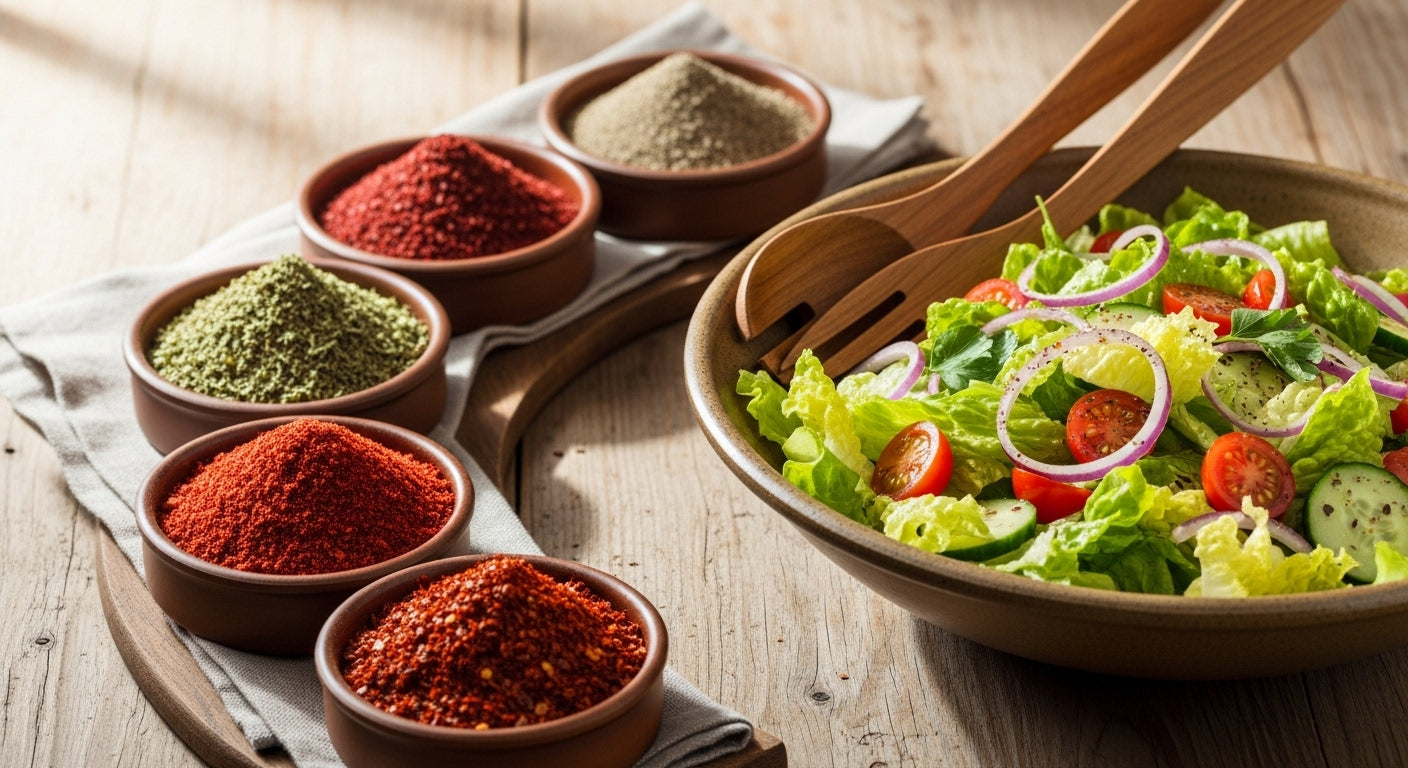
Salads hold an important place in Turkish cuisine and are commonly served both in everyday meals and on special occasions. The spices used are based on long-established culinary traditions and are selected to complement the main ingredients without overpowering them.
Traditional salad spices are usually simple and familiar. Their purpose is to maintain the freshness of the ingredients while creating a balanced overall structure. Because salads are light by nature, seasoning is kept equally restrained.
Regional food traditions influence which spices are preferred. The same salad can be prepared with different spices depending on the region, adding to the diversity of Turkish cuisine.
Spices in salads are used as supporting elements rather than defining ones, helping preserve the character of the dish.
Commonly Used Basic Spices in Turkish Salads
One of the most commonly used spices in Turkish salads is pul biber. Its fine texture allows it to spread evenly and it is often used in green salads for balance and colour.
Sumac is another traditional spice, particularly associated with salads containing onions. It can be sprinkled directly over the salad or mixed into dressings while maintaining overall harmony.
Dried herbs such as mint are widely used, especially in yoghurt-based and fresh salads. The grind size influences both texture and appearance.
Mild paprika powder is added mainly for colour and subtle seasoning, allowing it to be used across different salad types.
Choosing Spices According to Salad Types
Spice selection depends on the type of salad. Green salads typically use lighter seasonings, while tomato- and onion-based salads more often include sumac or pul biber.
Legume-based salads require slightly more pronounced seasoning. In these recipes, sesame is commonly used to add texture and visual contrast.
Yoghurt-based salads are seasoned more lightly, as the base already provides a strong structure. Dried herbs are usually preferred in these cases.
Selecting spices according to salad type ensures a balanced and cohesive result.
Proper Measurement and Use of Spices in Salads
Since salads are served cold, spices tend to be more noticeable. Small quantities are therefore sufficient to maintain balance.
Spices can be added directly or blended into dressings with oil and acidic components. Each method affects how evenly the seasoning is distributed.
Finely ground spices integrate smoothly, while coarser spices create more distinct accents, influencing both texture and presentation.
Balanced use of spices allows the main ingredients of the salad to remain in focus.