
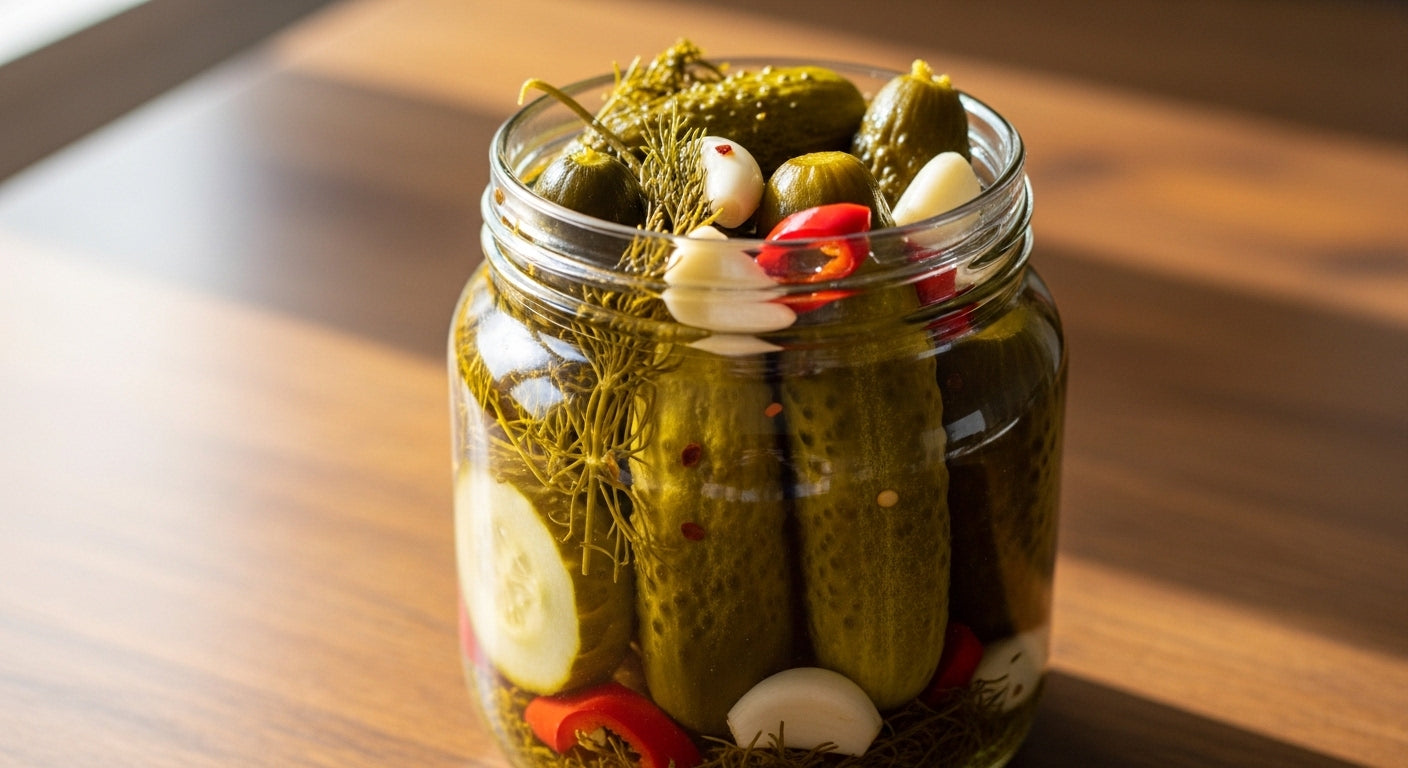
Pickles are products formed by keeping vegetables in a balance of salt and acid, which gives them a certain firmness. The balance established between the liquid and the vegetables inside a sealed jar helps preserve the structure of the product. Since there is no contact with the external environment in this closed system, internal conditions remain stable and pickles can maintain their original form for a certain period. However, once the jar is opened, this system is disrupted and the product begins to interact with external factors.
After opening, the environment in which the pickles are stored changes, and this change directly affects the structure of the vegetables. Contact with air, temperature differences, and changes in liquid balance become the main factors influencing the firmness of pickles. These interactions do not create an immediate effect, but gradually accumulate and lead to noticeable softening over time. Therefore, the softening process usually develops progressively.
The initial firmness of pickles is not only related to the production process but also to storage conditions. While the structure remains balanced when sealed, it cannot be preserved in the same way after opening. Contact with the external environment reduces the internal stability of the product. This effect becomes more evident especially in pickles that are used over a longer period.
For this reason, softening is not necessarily a sign of spoilage but rather part of a structural change process. Understanding this process helps explain why pickles change over time. Not all pickles soften at the same rate, as the type of vegetable, production method, and storage conditions directly influence the speed of this process.
What Are the Main Factors That Determine the Structure of Pickles?
The most important factor determining the structure of pickles is the cellular structure of the vegetables used. The fibrous composition and cell walls inside vegetables create the initial firmness. This structure does not completely disappear during fermentation; instead, it reaches a balance that forms the characteristic texture of pickles. Depending on the type of vegetable, this structure may be denser or softer, directly affecting firmness.
Salt level is one of the most critical factors in maintaining this structure. Salt helps draw water out of the vegetable, reshaping its cellular structure in the process. It also regulates fermentation, allowing the product to develop a stable form. When the salt level is insufficient, the structure becomes weaker, making the pickles more prone to softening over time.
The acidic environment also plays a key role. The acid formed during fermentation helps preserve the vegetable’s structure and provides resistance against external influences. The more balanced this environment is, the more stable the texture of the pickles becomes. When the acid balance is disrupted, the structure becomes more sensitive.
Production time is another determining factor. Pickles that undergo longer fermentation develop a more settled structure, while those prepared in a shorter time do not fully reach this balance. As a result, less matured pickles tend to soften more quickly after opening.
How Does the Softening Process Progress After Opening?
After opening, pickles begin to come into contact with air, which alters the internal balance. Oxygen, which is limited in a sealed environment, enters the jar and affects the structure of the vegetables. This leads to a gradual weakening of the cell walls, which becomes noticeable as softening over time.
At the same time, the liquid balance inside the jar changes. As pickles are taken out during use, the amount of liquid decreases or becomes uneven. When vegetables are not fully submerged, their outer surfaces are exposed more, causing structural weakening. This effect is especially visible in the upper layers.
Temperature also plays a significant role in determining the speed of this process. Pickles kept at room temperature after opening tend to soften more quickly. As temperature rises, the resistance of the vegetable structure decreases and the internal breakdown accelerates.
All these processes work together, gradually weakening the structural integrity of the pickles. Softening is not caused by a single factor but rather by the combination of multiple variables acting over time.
How Does Storage Affect the Texture of Pickles?
The environment in which pickles are stored plays a key role in preserving their texture. In stable temperature conditions, pickles can maintain their original structure for a longer period. However, fluctuations in temperature, especially after opening, accelerate structural changes. Constant environmental variation leads to faster breakdown of the vegetable structure.
Humidity is another important factor. Jars that are left open or not properly sealed are affected by the moisture in the environment. This can cause surface changes and accelerate softening. High humidity environments disrupt the stability of pickles.
Light and external exposure also contribute indirectly. Pickles that are left exposed for extended periods interact more with their surroundings, leading to faster changes. This is particularly noticeable in frequently used products.
The more stable the storage conditions, the longer the texture is preserved. Otherwise, the pickles gradually lose their original firmness and develop a softer structure.
When Does Softening Become More Noticeable?
Softening becomes most noticeable in pickles that are opened frequently. Each time the jar is opened, air enters and affects the internal balance. Over time, this cumulative effect accelerates structural weakening.
A decrease in liquid level is another key factor. Vegetables that are not fully submerged are more exposed to external conditions and therefore soften more quickly. This is often observed in the upper part of the jar.
Pickles prepared with lower salt levels are also more prone to softening. The structural stability in such products is weaker. Similarly, pickles that have undergone shorter fermentation tend to change more rapidly after opening.
When all these factors come together, the structure of pickles gradually changes. Softening is a natural outcome resulting from the combination of multiple conditions rather than a single cause.