
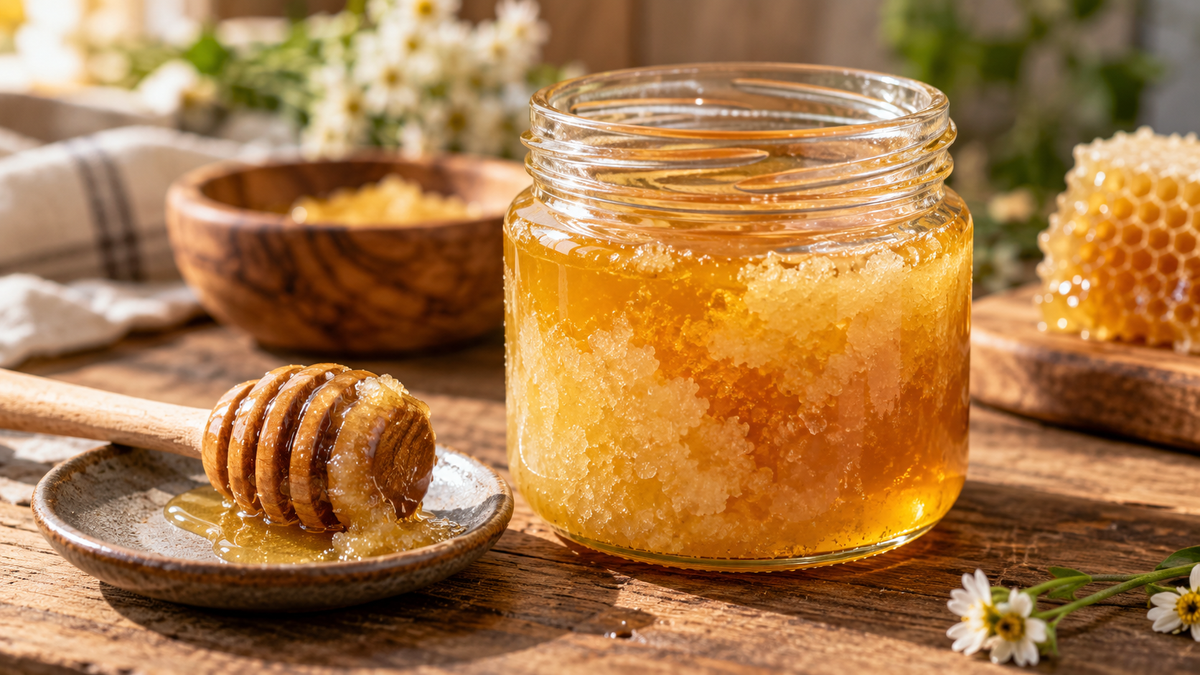
Honey crystallizes when its naturally fluid structure gradually turns into a thicker, grainy, or crystal-like texture. Filtered honey, flower honey, pine honey, and other honey varieties can crystallize at different speeds depending on storage conditions, natural sugar balance, and room temperature. This change mainly affects the appearance and consistency of the honey, but not every honey crystallizes in the same way or within the same period.
Although honey usually has a smooth and flowing texture when first opened, small sugar crystals can become visible over time. This change is often noticed more quickly in cooler environments. Some honey varieties may become almost solid, while others may show crystallization only at the bottom of the jar or around the edges. These differences are related to honey type, moisture level, storage method, and processing style.
Crystallized honey is often confused with spoiled honey because its glossy and liquid appearance changes. White areas, a matte surface, a grainy structure, or a thicker spoonable texture may appear inside the jar. For this reason, crystallization should not be evaluated only by appearance. Aroma, taste, consistency, and storage conditions should be considered together.
To keep honey easier to use for longer, storage temperature, lid closure, and the place where the jar is kept are important. Honey should not be stored in direct sunlight, very hot places, very cold areas, or locations with frequent temperature changes. When kept under suitable conditions, its texture changes more slowly and remains easier to use in daily serving.
What Does Honey Crystallization Mean?
Honey crystallization means that the natural sugars in honey form visible crystals over time. This turns the honey from a liquid appearance into a thicker and more grainy texture. White, matte, or granular areas may appear in part of the jar or throughout the whole product. This change can become more noticeable when honey has been stored for a long time.
Crystallization can look different depending on the honey variety. Some honey turns into a fine and creamy texture, while some forms larger crystals. Certain flower honeys may crystallize more easily, while other varieties may stay liquid for longer. Therefore, it is not expected that every honey type will show the same appearance or change at the same speed.
Many users mistake crystallization for spoilage. However, a crystal-like texture alone does not automatically mean that the honey is unsuitable for use. If there is an unusually sharp, fermented, or unpleasant smell, foaming, pressure in the jar, or a strong unexpected change, the product should be checked more carefully. A grainy texture alone is generally related to consistency change.
Crystallized honey can still be used, but it behaves differently in serving. Liquid honey spreads more easily on bread, pastries, or desserts. Crystallized honey is firmer and is taken with a spoon in a thicker form. If a softer texture is preferred, it can be warmed slowly and gently without exposing it to high heat.
Under Which Conditions Does Honey Crystallize Faster?
Room temperature plays an important role in honey crystallization. Honey kept in very cool places can lose its fluid texture faster and begin to form crystals. Pantries, cold cabinets, or areas with frequent temperature changes may speed up this process. For this reason, honey should be stored in a stable and moderately warm environment.
Moisture and air contact can also affect honey’s structure. If the jar lid is not tightly closed, honey can absorb moisture and surrounding odors. This may affect not only crystallization but also the general appearance and usability of the product. A wet spoon placed into the honey jar can also cause unwanted texture changes. Honey should always be taken with a clean and dry spoon.
The honey variety itself also affects how quickly crystallization occurs. Natural sugar balance, water content, and source can change the tendency of honey to crystallize. Some varieties crystallize sooner, while others remain fluid for a longer time. This should be understood as a structural difference between honey types rather than a simple quality difference.
The jar, light exposure, and storage location should also be considered. Honey should be kept in a closed jar, in a dry place, away from direct sunlight. Sunlight and high heat can affect its color and aroma. Frequent temperature changes may create different texture zones inside the jar. Stable storage helps preserve the honey more evenly.
How Can Crystallized Honey Be Made Softer Again?
The best way to soften crystallized honey is to place the jar in a controlled warm water bath. Honey should not be exposed directly to high heat, boiling water, or an open flame. Very high temperatures can affect its aroma and structure. A warm water bath works more slowly but gives a more controlled result.
For this method, the closed honey jar can be placed in a bowl filled with warm water. The water level should be arranged so that water does not enter the jar. After waiting for a while, the honey begins to soften gradually. If needed, the jar can be turned gently to help the texture become more even. It is important to make sure that no water gets into the honey.
Trying to melt honey quickly in a microwave, directly on the stove, or with boiling water is not a suitable method. Sudden high heat can change the consistency unevenly. Depending on the jar material, it may also create a risk of cracking or deformation. Honey should therefore be softened slowly and carefully.
Crystallized honey may not return completely to its original clear and flowing appearance, but it can become softer and easier to use. If the crystallization is very dense, the process can be repeated in short intervals. If the honey is then stored again in a cool place, it may crystallize once more. Softening only the amount needed can be more practical than repeatedly warming the whole jar.
How Should Honey Be Stored to Prevent Fast Crystallization?
It may not always be possible to completely prevent honey from crystallizing, but proper storage can slow the process. Honey should be kept in a dry place that is cool but not too cold, away from direct sunlight and major temperature changes. The refrigerator is generally not suitable for daily honey storage because low temperatures may speed up crystallization.
The jar lid should be closed tightly after each use. Honey left open can come into contact with air, moisture, and surrounding odors. This can affect both its consistency and aroma. In the kitchen, honey should not be left open near strongly scented products such as spices, coffee, onion, or garlic.
A clean and dry spoon should always be used. If water gets into the honey jar, the structure of the honey may change. Spoons that have touched other foods should not be placed directly into the jar. Keeping the contents clean helps preserve the honey’s own texture and aroma.
If honey is bought in a large jar, a small amount can be transferred to a separate serving container. This reduces how often the main jar is opened and limits air exposure. Honey that will be stored for a longer time should remain closed, dry, and in a stable-temperature area. This helps preserve its consistency, smell, and ease of use.