
Choosing honey is a process that goes beyond simple taste preference and requires evaluating multiple factors such as origin, physical characteristics, and production method. There are many types of honey on the market derived from different regions and floral sources, which can make the selection process more complex. Understanding the basic characteristics of honey helps distinguish between different products.
The appearance, consistency, and aroma of honey provide important clues about the product. However, none of these factors should be evaluated in isolation. The production process, storage conditions, and handling methods all directly influence the overall structure of honey. Therefore, selecting honey requires a comprehensive approach.
Variations in color, density, and flow are natural and occur because honey is not a standardized product. These differences are related to its natural origin rather than being defects. Instead of expecting uniformity, recognizing the natural diversity of honey leads to a more accurate evaluation.
In this context, the key aspects to consider when choosing honey include its origin, physical properties, composition, and differences between types. Evaluating these aspects together allows for a more informed decision.
How Do Origin and Production Methods Affect Honey Selection?
The origin of honey is one of the most important factors determining its character. The diversity of plants from which bees collect nectar directly influences both the aroma and color of the honey. Polyfloral honey offers layered flavor profiles due to multiple floral sources, while monofloral honey tends to present a more distinct and consistent character.
Production methods also affect the structure of honey. Honey produced using traditional techniques may differ from that produced through more controlled processes. These differences are often reflected in the texture, density, and overall appearance of the product.
Processing steps such as filtering, straining, and resting can influence clarity and flow. Each stage plays a role in shaping the final product. Understanding how honey is handled after harvesting helps interpret its visible characteristics.
When origin and production are considered together, a clearer picture of the honey’s overall structure emerges. These factors are fundamental in defining the product’s identity.
What Do Consistency, Color, and Flow Indicate?
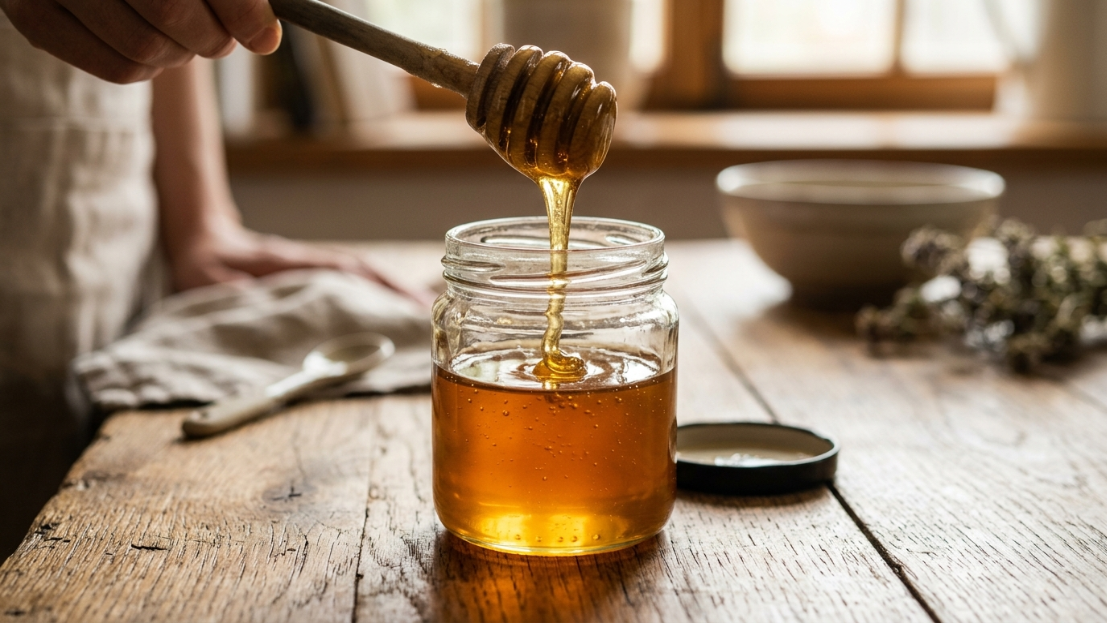
The consistency of honey provides insight into its density. Some honeys are more fluid, while others are thicker and more viscous. This variation is often linked to the floral source and environmental conditions during production.
Color is another important indicator. Lighter honeys tend to have a milder profile, while darker honeys may appear richer and more intense. However, color alone does not determine quality, as each type has its own natural range.
Flow behavior is influenced by temperature and storage conditions. At lower temperatures, honey becomes thicker and flows more slowly. This is a natural response rather than a sign of change in quality.
Evaluating consistency, color, and flow together provides a more complete understanding of the product. Focusing on a single attribute may lead to incomplete conclusions.
How Can Honey Composition and Purity Be Interpreted?
The composition of honey offers important clues about its natural structure. Honey that retains its original components without excessive processing maintains its characteristic properties. These traits can often be observed through its texture and behavior.
Over time, honey may undergo visible changes such as thickening or crystallization. These changes are related to its natural composition and environmental conditions. They should be interpreted as part of the product’s nature rather than as irregularities.
Assessing purity requires a holistic view. Appearance, texture, and overall behavior should be evaluated together instead of relying on a single indicator. This approach provides a more accurate understanding of the product.
Understanding composition helps differentiate between products and highlights the natural diversity found in honey.
How Do Different Types of Honey Differ from Each Other?
Honey types vary primarily based on their nectar source. Polyfloral honey is derived from multiple plant species, while monofloral honey comes from a single dominant source. This distinction creates noticeable differences in aroma and structure.
Each type of honey has its own characteristic consistency and color. These properties are shaped by environmental conditions and floral diversity. As a result, natural variation between types is expected.
Production techniques also influence these differences. Even honey from the same source can display variations depending on how it is processed and handled.
When all these factors are considered, the differences between honey types become more apparent. These variations define the unique characteristics of each product.