
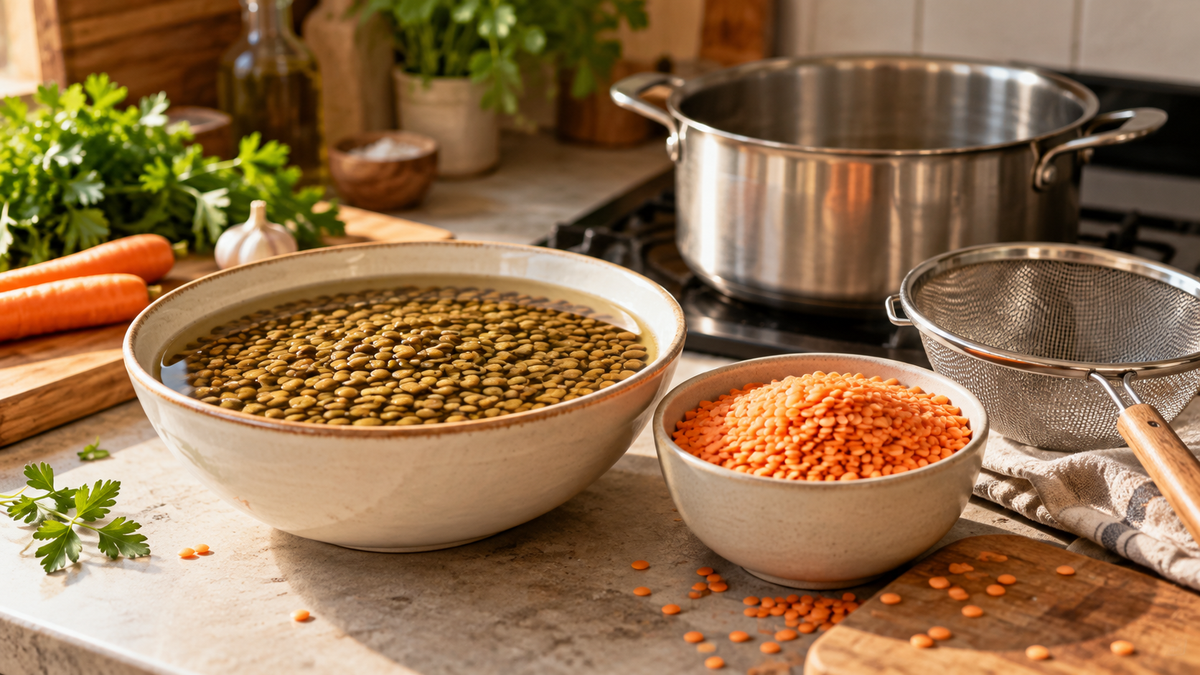
Lentils generally do not need to be soaked before cooking. Red, yellow, and green lentils can usually be cooked directly after sorting and rinsing. Red lentils, which are often sold split and with their outer skins removed, become tender relatively quickly. Green lentils usually retain their skins and have a firmer structure, so they may require a longer cooking time. Soaking can shorten cooking in some cases, but it is not essential for most lentil recipes.
One of the most important preparation steps is checking and rinsing the lentils. Small stones, foreign particles, or damaged grains should be removed before cooking. The lentils can then be placed in a strainer and rinsed under running water. Rinsing is different from prolonged soaking and remains useful even when the lentils will be cooked immediately.
Whether lentils should be soaked also depends on the intended dish. In red lentil soup, the grains are usually expected to soften and break apart, creating a creamy consistency. In green lentil salads or certain stews, the individual lentils are often expected to remain relatively intact. These different outcomes may require different preparation and cooking techniques.
The amount of water and the cooking duration also determine the final texture. Excessive liquid can make a dish too watery, while insufficient water may prevent lentils from becoming fully tender. The correct approach depends on the variety, grain size, storage conditions, and desired consistency of the finished recipe.
Is It Necessary to Soak Lentils in Water Before Cooking?
Long soaking periods are generally unnecessary for most lentil varieties. Compared with many other dried legumes, lentils have relatively small grains and absorb water fairly quickly during cooking. Red lentils, in particular, can usually be cooked without any preliminary soaking. Leaving them in water for several hours may cause them to soften early and break apart more rapidly when heated.
For green lentils, short soaking is optional. It may help reduce the cooking time of larger grains or lentils that have been stored for an extended period. However, green lentils do not generally require overnight soaking. Many recipes simply call for rinsing the lentils and cooking them directly in water or broth until the desired consistency is reached.
When soaking is preferred, the lentils should first be sorted and washed. They can then be placed in clean water for a period appropriate to the variety and recipe. If a long soaking period is used, the container should be kept in the refrigerator. Leaving legumes in water at room temperature for extended periods, particularly in warm kitchens, can encourage unwanted microbial growth.
After soaking, the water should be drained and the lentils cooked with fresh water. Because soaked lentils have already absorbed moisture, they may become tender more quickly than unsoaked lentils. Cooking should therefore be monitored earlier than usual. This is particularly important for recipes in which the lentils are expected to maintain their shape.
Is Soaking Different for Red and Green Lentils?
Red and green lentils differ in structure, which influences how they absorb water and soften during cooking. Red lentils are frequently sold as split lentils with their outer skins removed. This allows water to reach the interior more easily. As a result, red lentils cook quickly and often break down into a smooth mixture, making them particularly suitable for soups.
Green lentils are generally sold as whole grains with their skins intact. Their firmer structure allows them to maintain their shape longer than split red lentils. They are commonly used in salads, vegetable dishes, and soups where individual grains should remain visible. Although soaking may reduce cooking time in certain recipes, green lentils can also be cooked directly.
For red lentils, rinsing is normally sufficient preparation. The lentils are placed in a strainer, washed, and transferred to a saucepan with the amount of water or broth specified in the recipe. Prolonged soaking is not necessary for a smooth red lentil soup. During cooking, the grains naturally soften and gradually lose their original shape.
Green lentils require more attention to the desired final texture. For salads, they should be cooked until tender without becoming excessively soft. In stews, a softer consistency may be appropriate. If green lentils have been soaked beforehand, their cooking time may be shorter. The liquid quantity and cooking duration should therefore be adjusted accordingly.
What Happens If Lentils Are Cooked Without Soaking?
Lentils can become fully tender without soaking when sufficient water and appropriate cooking time are provided. Many red lentil recipes are specifically designed for direct cooking. This makes preparation straightforward, particularly when preparing soup. The lentils absorb water, soften, and eventually form a thicker mixture as they cook.
Green lentils may require more time when cooked without soaking, especially compared with red lentils. However, this does not mean they will remain hard. With enough liquid and steady heat, green lentils can soften completely. Direct cooking may even make it easier to monitor their firmness in recipes where the individual grains should remain intact.
Water absorption varies according to lentil variety, size, and skin structure. Split red lentils may break apart quickly, while whole green lentils can retain their shape for longer. Cooking time should therefore not be determined solely by the number of minutes stated in a general guide. The tenderness of the grains and the consistency of the dish should be checked during cooking.
Rinsing should not be skipped simply because the lentils are not being soaked. Depending on their production and packaging conditions, lentils may contain dust, small plant fragments, or other foreign particles. Sorting and washing are useful preparation steps. Once cleaned, the lentils can be cooked directly using the appropriate quantity of liquid.
How Should Cooking Time and Water Ratios Be Adjusted for Lentils?
Cooking time and water ratios should be adjusted according to the lentil variety and the desired consistency. Red lentils often become tender in approximately 10–20 minutes, while green lentils may require around 20–40 minutes. These are general estimates rather than fixed rules. Grain size, storage conditions, and previous soaking can all influence the actual cooking duration.
For red lentil soup, many recipes use approximately three to four measures of water for every measure of lentils. However, the amount depends on the desired thickness and whether vegetables such as potatoes, carrots, or onions are included. Red lentils absorb liquid and break down during cooking, causing the soup to thicken gradually. If necessary, small amounts of hot water can be added to adjust the consistency.
Green lentils also require sufficient water, but the amount depends on how they will be served. When boiling lentils for a salad, they can be cooked in plenty of water and drained once tender. For a stew, the liquid quantity should account for the other ingredients. If keeping the lentils whole is important, their texture should be checked regularly toward the end of cooking.
Cooking temperature affects the final result. Prolonged vigorous boiling may cause red lentils to break down quickly, which can be desirable for creamy soups. However, the same approach may cause green lentils to split when preparing a salad. Reducing the heat after the water begins to boil allows more controlled cooking and makes it easier to achieve the intended texture.
After cooking, the lentils should be handled according to the recipe. Red lentil soup can be blended for a smoother consistency. Green lentils intended for a salad can be drained and allowed to cool. In stews, the cooked lentils may simmer briefly with the remaining ingredients to combine the flavors. With suitable water quantities and careful cooking, each lentil variety can retain the characteristics needed for the finished dish.